
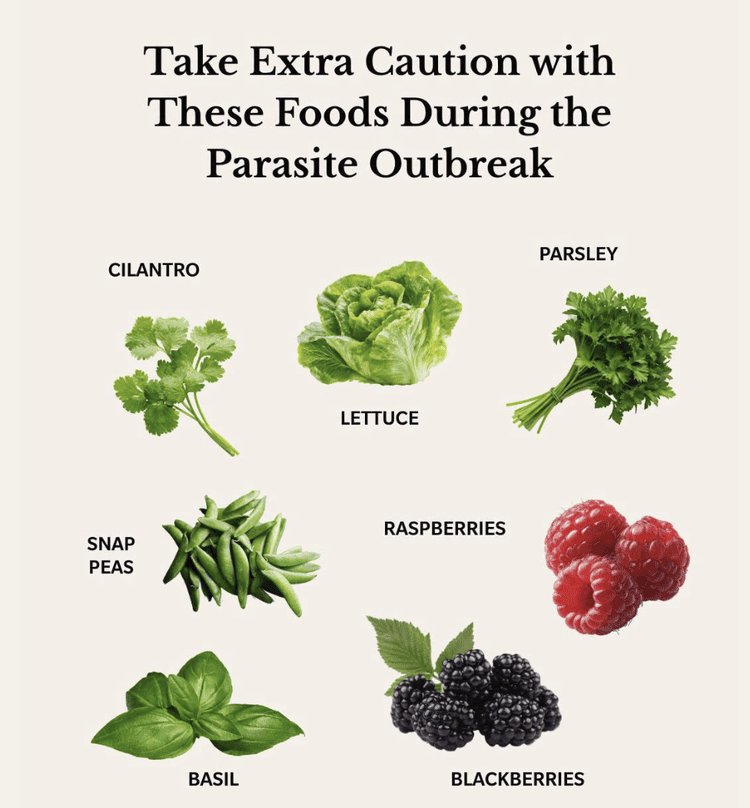
This summer's cyclosporiasis outbreak has now become the largest on record in the United States, surpassing the previous all-time high of roughly 4,700 cases set in 2019, with Michigan alone reporting over 3,700 cases, more than 65 times its typical annual total. Fresh produce, particularly leafy greens, herbs such as cilantro and basil, and berries, remains the leading suspect. We wanted to make sure our patients and clients have clear, practical information.
YOUR RISK
Cyclospora spreads through food or water contaminated with Human feces, not from person to person. Past outbreaks have been linked to lettuce and salad mixes, cilantro, basil, snow peas, and raspberries, almost always eaten raw. Anyone can be affected, but infectious disease specialists identify young children, older adults, and anyone who is immunocompromised or managing a chronic condition as most at risk for a harder, longer course of illness.
SHOPPING SMART: WHAT TO BUY AND HOW
Choose whole, uncut produce over pre-cut or bagged: Pre-cut, bagged, and pre-mixed items, such as salad kits, cut fruit cups, or salsa, pass through more hands and equipment during processing, which multiplies contamination opportunity. A whole head of lettuce or an intact fruit is the lower-risk choice whenever that option is available.
Peeled produce are the safer choices right now: Peeling is highly effective for any item with removable skin, since Cyclospora sits on the outer surface rather than inside the flesh.
There is no “safer brand” to switch to yet: No grower, supplier, or specific product has been recalled or confirmed as the source. Switching to a different bagged salad brand is not a protective step right now; the risk sits at the food-category level (raw leafy greens, herbs, berries), not with any particular label.
Do not read “prewashed” as “safer”: A “prewashed” label simply means the item does not need to be washed again at home; it is not a claim that the item carries lower risk in this outbreak.
At restaurants and delis, ask before assuming: For cilantro, basil, and other fresh herbs, ask whether they can be substituted with a cooked or dried alternative, or request them left off raw preparations such as salsa or garnishes.
Hold onto receipts and packaging for produce for a few weeks after purchase. If a specific brand or grower is later identified, this is the only way to know whether something in the kitchen was part of it.
PRECAUTIONS TO TAKE NOW
Rethink bagged greens: Choose whole heads of lettuce over pre-washed bagged salad mixes when possible, and remove the outer two to three leaves.
Wash produce well: Rinse leafy greens, herbs (cilantro, basil), and berries thoroughly under running water. Washing reduces risk but cannot fully remove the parasite, so this is a risk-reducer, not a guarantee.
Cook when possible, as this is the one method that works: Heating produce to 158°F is the only reliably effective way to kill the parasite. Cooking leafy greens and herbs when possible is the most protective step available.
Do not rely on your freezer: Standard home freezing does not reliably kill Cyclospora. Laboratory studies show true inactivation requires sustained deep-freeze temperatures, around –4°F for 24 to 48 or more hours, well beyond a typical home freezer. Frozen berries may reduce risk somewhat but should not be treated as “safe.”
Be extra cautious with high-risk items right now: especially cilantro, basil, snow peas, and pre-cut salad mixes. Raspberries have the strongest outbreak history of any berry; blackberries and strawberries share the same raw, hard-to-clean risk profile and are worth the same caution.
Wash your hands thoroughly with soap and water before and after handling raw produce.
Refrigerate pre-cut or pre-prepared produce promptly if you are not eating it right away.
SOURCE IDENTIFIED:
TAYLOR FARMS ICEBERG LETTUCE
Health officials have now identified the source of the outbreak. The FDA traced the illnesses to shredded iceberg lettuce supplied by Taylor Farms de Mexico, prompting a voluntary recall of affected products distributed to restaurants, food service providers, and retailers in multiple states.
This finding has also renewed attention on Taylor Farms, whose products were linked through traceback investigations to the deadly 2024 multistate E. coli O157:H7 outbreak involving leafy greens.
Consumers should not eat recalled iceberg lettuce or products made with it, should discard any affected items, and should check FDA recall notices for affected lot numbers and use-by dates.
SUPPLEMENT SUPPORT
We looked closely at where supplements might reasonably fit into recovery or general resilience during this outbreak.
Allicin (garlic-derived): In an animal study, garlic's active compound reduced oocyst counts and improved intestinal healing in a coccidian parasite from the same broader family as Cyclospora (Cryptosporidium), which is the closest laboratory evidence found relating to this outbreak.
Probiotic support (post-recovery): A multi-strain probiotic such as our Microbiome18 has a genuine, well-established evidence base for helping restore gut flora after a GI infection or after a course of antibiotics, including the antibiotic used to treat cyclosporiasis. It’s role here is to support recovery afterward, not to fight the parasite itself.
A NOTE FROM MY PRACTICE
For anyone managing a chronic condition, an active gut infection adds real strain, to digestion, to nutrient absorption, and to overall recovery capacity. If symptoms develop, please loop us in alongside your physician so we can support gut and immune function through recovery, not just treat the infection in isolation. As always, we are here if you have questions.