

Tattoos are now more common than ever — roughly 30% of American adults carry at least one, and nearly 40% of adults under 35. What most people don't know is that the ink injected into the skin doesn't simply stay there. A growing body of peer-reviewed research — including landmark studies published in 2024 and 2025 — has changed what clinicians understand about how tattoo ink behaves inside the body over time.
This alert is not intended to alarm you. If you have tattoos, there is meaningful action you can take. And if you are considering one, there is important information worth knowing first. As always, our goal at The Khader Center is to give you the science — clearly and honestly — so that you can make informed decisions about your health.
WHAT HAPPENS WHEN INK ENTERS THE SKIN
Tattoo needles deposit ink 1 to 2 millimeters into the dermal layer. The immune system immediately recognizes this as a foreign intrusion and dispatches macrophages — white blood cells designed to engulf and neutralize foreign particles — to the site. Because the ink particles are too large to be cleared, the macrophages trap and hold them in place. This is why tattoos are permanent.
The problem is what happens next. As macrophages eventually die, they release their ink burden back into the dermis — and the cycle begins again. Meanwhile, the smallest ink particles, known as nanoparticles (less than 100 nanometers), are small enough to escape this trapping mechanism entirely. They migrate.
THE LYMPH NODE CONNECTION
This is the finding that has drawn the most attention from researchers in recent years: tattoo ink nanoparticles travel through the lymphatic system and accumulate in the lymph nodes — permanently.
A 2025 study published in the Proceedings of the National Academy of Sciences (PNAS) confirmed that tattoo ink rapidly drains to the lymph nodes, where macrophages take it up and often undergo cell death, triggering persistent inflammation that continues for months after the tattoo is made. In some cases, nanoparticles have also been detected in the liver and spleen.
Why does this matter? The lymph nodes are a critical pillar of immune defense. They filter pathogens, produce immune cells, and help coordinate the body's response to infection, vaccination, and cancer surveillance. Chronic inflammation in lymph nodes — sustained by decades of ink particle accumulation — is a recognized risk factor for abnormal cell growth.
2024 Research Finding (University of Southern Denmark / University of Helsinki):
Using Danish twin pair data, researchers found that tattooed individuals are diagnosed with lymphoma and skin cancers more frequently than non-tattooed individuals. The authors attribute this to chronic immune activation triggered by ink accumulation in lymph nodes.
Source: Nielsen et al., eClinicalMedicine, 2024
THE HEAVY METAL BURDEN
Tattoo inks are not simple dyes. They are complex chemical mixtures — many of them originally formulated for industrial use in car paint, plastics, and printer toner — that contain pigments, preservatives, solvents, and significant trace metal contamination.
A 2025 study published in the International Journal of Environmental Research and Public Health tested 41 commercially available inks sold in the European Union and found that the majority exceeded established safety limits for one or more heavy metals. Among the metals documented in tattoo inks across multiple studies:
Lead — linked to neurotoxicity and cardiovascular damage
Mercury — linked to kidney damage, immune disruption, neurological effects
Cadmium — classified as a Group 1 human carcinogen
Arsenic — Group 1 carcinogen; disrupts cellular energy metabolism
Nickel and Chromium (VI) — potent allergens; chromium is carcinogenic
Cobalt — associated with cardiac toxicity and granuloma formation
Copper — present at extremely high concentrations in many inks
These metals do not remain neatly confined to the tattoo site. Once solubilized into nanoparticle form, they follow the same migration pathway as the pigments — traveling through lymphatic channels and entering systemic circulation.
INK COLOR RISK PROFILE
Not all ink colors carry equal risk. The heavy metal composition varies significantly by color. The table below summarizes what the research shows:
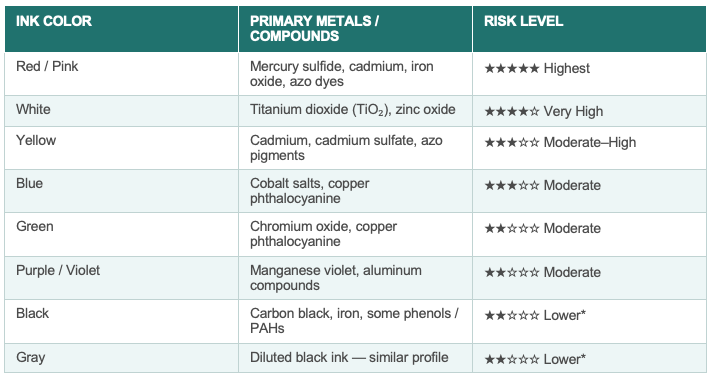
* Black ink nanoparticle concentrations can still be high; carbon black has been linked to PAH (polycyclic aromatic hydrocarbon) contamination.
IF YOU ARE CONSIDERING A TATTOO: WHAT TO ASK AND WHAT TO CHOOSE
If you are planning to get a tattoo and are working to minimize health impact, here are evidence-informed choices:
Request organic or plant-based inks. Vegetable-based pigments are less likely to contain heavy metal contaminants and are generally more biocompatible. Ask your artist which brands they use and whether they can provide ingredient transparency.
Avoid high-risk colors where possible. Red and white carry the heaviest metal loads. If you want color work, ask about safer pigment substitutes — naphthol-based reds, copper phthalocyanine blues and greens, and arylide or turmeric-based yellows are better alternatives.
Consider size and density. Smaller, less densely filled designs mean less total ink burden. Line work introduces less pigment volume than fully shaded or colored fills.
Avoid the upper deltoid if you receive regular vaccines. New research suggests that tattoo-related lymph node inflammation in the draining lymphatic zone can affect vaccine immune response. The upper arm is the most common vaccination site.
Choose a reputable artist and studio. Sterile technique, single-use needles, and licensed professional environments reduce infection risk significantly.
Before any tattooing, we recommend running a baseline heavy metal panel. This gives you a pre-tattoo reference point and helps us identify any existing burden that should be addressed first.
A FINAL WORD
We are not suggesting that everyone with a tattoo is in crisis. The research is clear that most tattooed people do not experience dramatic acute illness. What the science now confirms is that tattoo ink is not biologically inert — it interacts with the immune system, burdens the lymphatic system, and introduces heavy metals that the body must work to manage over a lifetime. For patients who are already working to reduce their toxic burden, support immune function, or address chronic inflammatory conditions, tattoos are a relevant and meaningful variable.
If you have questions about what this means for your individual health picture, or if you would like to schedule a heavy metal assessment and consultation, please reach out to us. This is exactly the kind of conversation we are here for.
This alert is provided for educational purposes. It is not a substitute for individualized clinical evaluation. Sources include peer-reviewed publications in PNAS (2025), eClinicalMedicine (2024), the International Journal of Environmental Research and Public Health (2025), and the Journal of Hazardous Materials (2025).